How to Write a Drum Chart, Part 1: Charts vs. Transcriptions
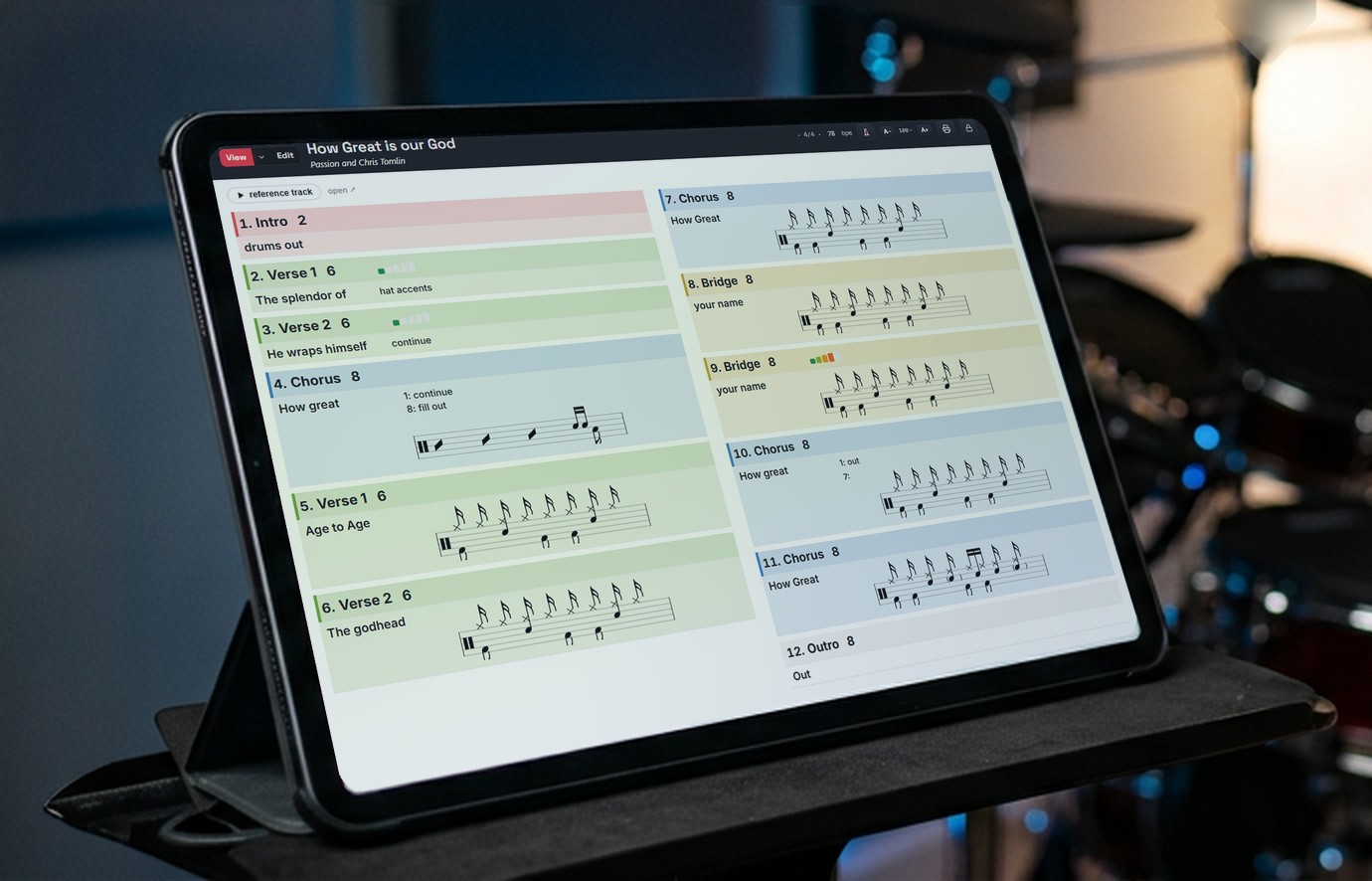
What should we play when performing a song? That is a question every drummer, or any musician, needs to ask. The answer is not always "play what the song's original drummer played". That is probably the safe answer, and it should be the default choice.
My best answer to the question is: "play what is expected of you". So who sets the expectations? If you are on a worship team, it is the worship leader or music director. If you are in a rock band, it could be whoever the band leader is, which could be you.
Even if there are other people in that role, there may still be no expectation given, or at least none stated. In that case, is it best to be faithful to the original or to put your own spin on it? I won't answer that here, because it is a musical decision we as drummers learn to make through experience. The wrong decision could cost you a job. However, it never hurts to be able to play the original as it was recorded as a starting point, then take the song where it needs to go.
How do we know what the original drummer played?
Ideally, just listening to the song should be enough. But it is often hard to pick the part out exactly, especially in a complex song or when the drums are not prominent in the mix. There are tools to help: YouTube videos, software that slows a song down, and AI packages that isolate the drum part. I prefer to do this with my ears only, but if you really want to nail a part, or you realize after watching another drummer that you got it wrong, you may need to add some of these crutches.
What is a drum transcription?
A drum transcription is an exact notation of what a drummer plays on a specific piece. Transcriptions use standard drum notation on a standard musical staff, and all the rules of musical notation apply. A transcription should be usable by any drummer who wants to see how the original drummer actually played the piece. It is also of great value as a learning tool. The finished transcription is generally a long document, depending on the length of the song.
Whether you try to replicate the original drummer is up to your judgment and will depend on the drumming situation you are in. Often, exact replication is not needed. In my experience, even when I wanted to figure out the exact parts, the process was time consuming and not worth the effort. The original parts may not work best in your current band or the current live situation. Things vary even more in a live performance, where it is often necessary to spice things up: perhaps the original studio recording was a bit reserved and the room needs more energy. It may be just reading the energy of the rest of the band, or it may be putting your own spin on parts of the song.
What is a drum chart?
Compared to transcriptions, drum charts have no rules and no standard format. A drum chart is a free-form guide to a song. It can be written at any level of detail you need, in any format that works.
So, whereas a transcription maps out what the original drummer played, a drum chart maps out how YOU are going to play it. Because it is built for you, a drum chart may not be useful to every drummer who needs to play the song. The chart may be specific to one band's arrangement and to the needs of the drummer who will be playing it, and it often uses nonstandard shorthand that might only make sense to its author.
The same song, both ways
Let me contrast a transcription and a chart of the same song, "How Great Is Our God". This is the song I chart out and perform in the companion video to this article.
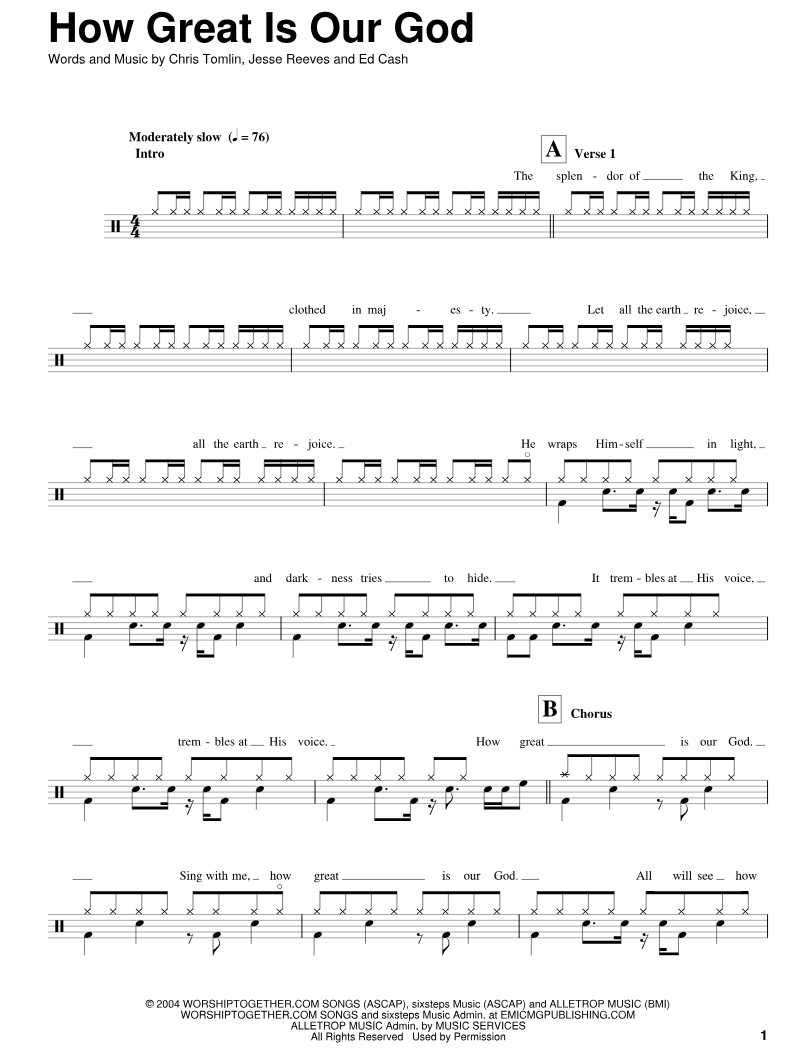
The first page of a drum transcription posted on MuseScore.
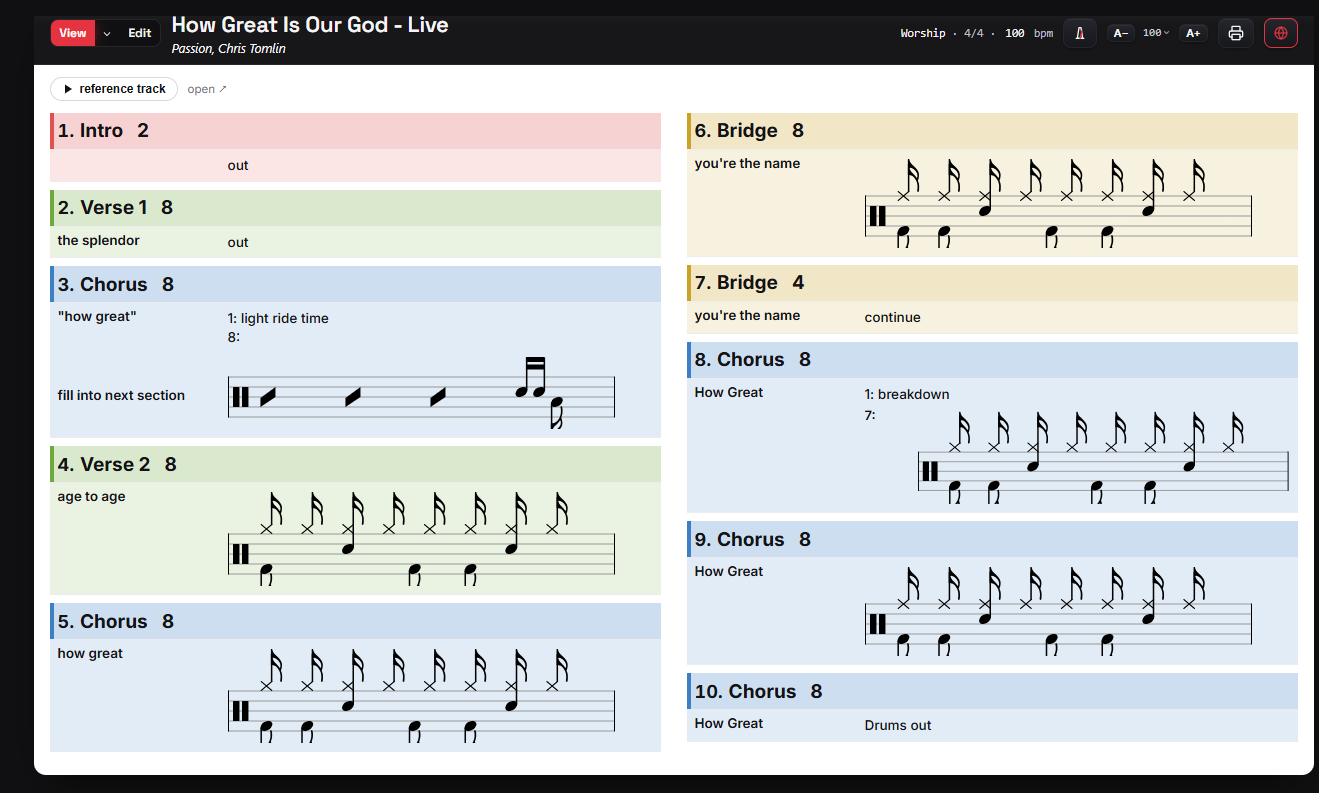
The drum chart I made for the video, and the one I use to perform at church.
One page of the transcription gets only partway through the third section, the first chorus. The whole chart fits on one page with room to spare.
I don't show the hi-hat accents on my chart, but if you watch the video I am accenting on the hats. A decision like that is often made on the fly, so a cue of "out" just means keep it down. I also don't include the fills in my chart. You can, if you want to make sure you memorize a specific fill. Some fills I memorize, but you can often just fill as the music and your judgment require. The same fills or different fills each time you play the song? I do both, depending on the song and the situation.
You don't need software to chart a song
We don't even need software like ChartBlazer to do this. I am not a big fan of pen and paper (for just about anything), but here is a chart I made in Microsoft Word, before I had ChartBlazer, for a set where I only had room to tape one page to the drum set.
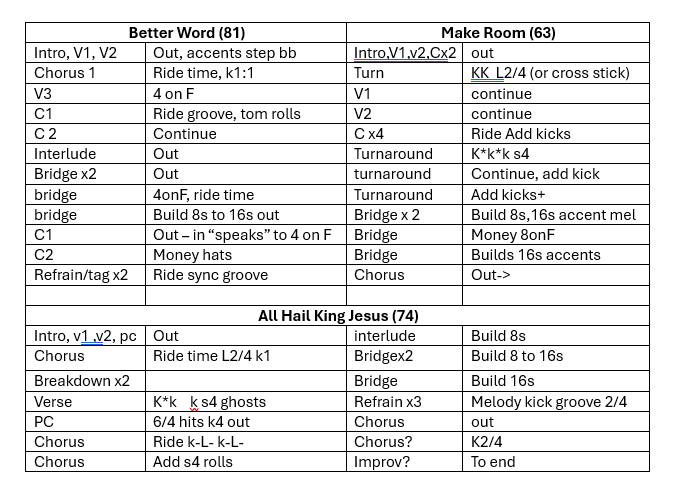
I still prefer having an app where I can easily get to all my charts. Sometimes the worship leader will change the set just before rehearsal, so it is nice to have every song available at any time for viewing and editing. And if you haven't played a song in a while, it is easy to forget your earlier decisions and what worked in the past (though you should always change and improve things when called for).
Why chart a song you already know?
Even if you know the song inside and out and don't need a chart live, the process of charting a song is the best way I know to learn it. I also like to have a chart on stage, if the situation allows one, in case I lose track of the song and need a reminder.
Next: the charting process
In the next part of this series, we'll step through the charting process. If you can't wait, this video gives a full overview. The series will go into some additional detail.